
This time with our alumnus Tobiáš Frýdl, a third-year production student at FAMU, the son of a priest from the Hussite congregation in Vršovice, and a production member of the Vršovice MANA Theatre.
To bear is to bear one’s own fate
Tobiáš is a publicly active young person. He is not indifferent to current social issues and seeks to engage with them publicly. Alongside his studies in production at FAMU, he works in production at the Vršovice MANA Theatre. In the near future, he is about to leave to shoot a documentary in Georgia on the topic of queer people dating in a homophobic environment.
You are studying film production at FAMU. Why did you decide to focus on film and production?
Since I was a child, I felt that I enjoyed filming and creating in general. FAMU felt like a natural path for me. At the same time, I mainly move in the theatre environment. During the entrance exams at FAMU, I was asked why I didn’t go to DAMU. That made me ask myself why, actually—since theatre is naturally closer to me. But maybe that is exactly the reason. Because theatre is closer to me, film feels less accessible and perhaps therefore more attractive. What interested me about production was the combination of the practical, organisational side with the artistic one—the connection between the rational and the creative world.
How do you see your development from wanting to become an actor, through film directing, to studying film production?
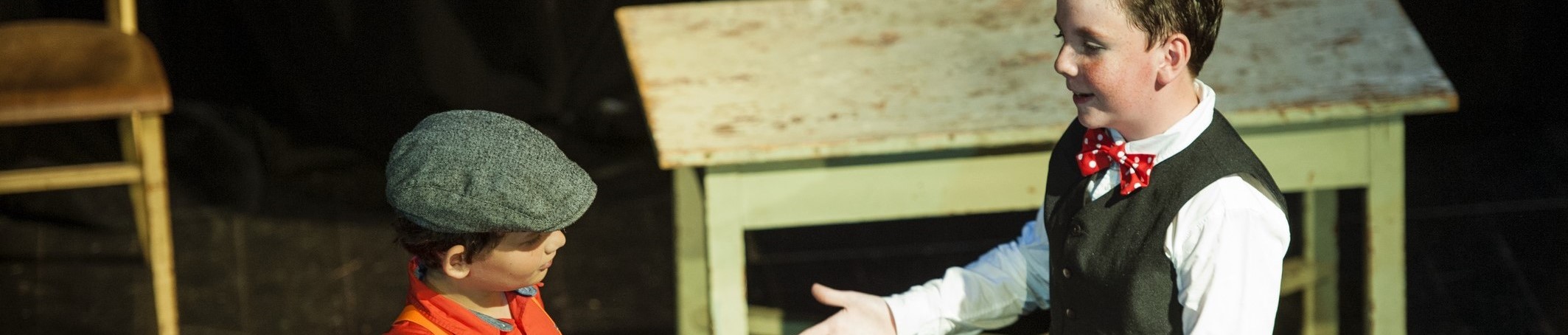
My path to creation was born out of necessity. With a group of four friends, we spent our earliest childhood together and got bored. We would ask ourselves what we could do, and we came up with the idea of filming something. It started as a way to kill time, which gradually turned into a hobby. The same happened with theatre. You began and told your father that there were no boys in the club. He sent us to TALENT, saying: “Go, maybe you’ll enjoy it.” In the end, it got me.
Why did you eventually move away from acting?
When I came to TALENT, I really started enjoying acting. At the age of five or six, I would say: “I’m going to be an actor.” But because I also moved in a professional theatre environment, I was able to see the other side of acting. You don’t just see the stars, great roles, and big productions—you also see the enormous amount of hard work behind it. The number of people who want to do it, who may even be good at it, but don’t get the opportunities. That is what discouraged me from acting and shifted me from being in front of the camera or on stage to working behind the camera and into the backstage world.
You are part of the amateur theatre company Sumus. Why did you decide to keep acting?
I enjoy it. But it’s exactly in amateur theatre that only the pure joy of acting remains. It is stripped of everything that discouraged me about acting. There is no need to present myself anywhere, to push or try hard. There is no ambition to sell myself, break through, become famous, or gain other roles through it.
Joy is the foundation of creativity.
I see that also in school. When collaboration with a particular director doesn’t suit me, I stop enjoying it and it becomes hard to find meaning in the work. When joy disappears, creating also becomes more difficult.
Do you experience the same joy in filmmaking as you do in theatre?
For me, FAMU was a goal for ten years, almost an idol. I never looked beyond the horizon. But the longer I am there, the less I know what comes next. And the longer I stay in theatre—which I thought I would eventually leave—the less I can imagine giving it up. At the same time, I still enjoy film, but maybe in a different way than I expected. When I started school, I thought I would make big feature films. Now I am more drawn to documentary work and smaller projects. But then there is the question of how to make a living from it. On one hand, I know exactly what I enjoy; on the other, I also know it might not be financially sustainable. It is a strange inner split.
How do you work with the point of not-knowing?
Whenever I start thinking about it, I panic. What helps me is to focus on what is happening right now—what I enjoy at this moment, what I want to do, what I am able to do. My grandfather, a poet and a doctor, has a beautiful short poem FateIt calms me when I remember that even my own burden is carried one day at a time. From a longer perspective, I try to reduce everything to what I am doing right now—what I enjoy—and not to worry about whether it will support me in five years. I entered the project I filmed last year with this attitude. That I want and need to film, without overthinking whether it would be beneficial for my future work or career. It will somehow unfold on its own.
If you look at yourself 15–20 years from now, where do you see yourself?
That was the first question I was asked in a workshop at FAMU. When my turn came, I felt embarrassed to say I didn’t know. I realised that I don’t think in that way at all. It doesn’t really interest me. Whether I will be more in theatre or film, or somewhere completely different—I have no idea.
In today’s society, people are expected to have clarity about everything immediately. As if a person did not have the right not to know.
I feel the pressure in society that if a person is not already working on their “great future life” ten years ahead, they are wasting time. But I don’t let that stress me out. People feel that they already have to know. When I imagine my father, a priest, one day becoming a theatre director—moving from Vysoké nad Jizerou to a parish where there is a theatre under the house, and then becoming its director. Or my grandfather’s life, who similarly ended up as a rural doctor almost by chance. Both of them completely found themselves in it. It was all random.
Does faith help you with this?
Yes, definitely. The idea that there is some entity that has a path prepared and planned for a person, and leads them along it without them knowing how, is a starting point in my life… I mean this perspective.
How does this relate to human freedom—active influence and decision-making in one’s own life? How do you perceive this paradox?
It is not contradictory at all. I believe that a human being is a free creature who can make their own decisions, but at the same time I believe that these decisions are not random. It is precisely in hindsight that a person can observe the moments that defined their path.
What does reflection and self-reflection mean to you? Looking into yourself, at your steps in life and your personality?
I like the title of a book (which I haven’t read yet), a conversation book by Erik Tabery with Zuzana Čaputová. Not to lose myselfIt is important for me, when I look back at my steps, to perceive authenticity in what I have done and how I have behaved. Returning to the question of where I will be in 15 years, I would simply like what I have done to make sense to me—to not lose myself. Not to start working or creating somewhere just because one “has to,” or out of inertia, or because I once set a goal and feel I must achieve it. I want to be able to stand behind my steps, to know I made them out of joy, goodwill, or good intention. At the same time, I sometimes realise that I was driven by more self-serving motives. That is the moment of self-reflection for me—when I acknowledge that I did not act entirely correctly.
In your documentary Faith in the colours of the rainbowwhich received the Jan Opletal Award, represent a more open stance of religious representatives towards various LGBT issues. Why did you decide to make this project?
In our family, although I come from a believing background, LGBT was never a topic or a problem. But I perceived a deeply rooted idea in the media that Christianity and the queer world exclude each other. Some people also immediately put my father, a priest, into a category of what he must think about LGBT issues. It was then nice to be able to say: no—why? If someone comes from a religious family, or is a priest, why should that automatically mean they oppose these topics? I know dozens of priests who have absolutely no problem with LGBT people. So I wanted to show that faith and the LGBT world do not have to exclude each other, and to present a positive perspective. I was often criticised for it: “Yes, but it’s not objective, you only show one side.” But I think that the public discussion on church and homosexuality is not objective either—it is one-sided. When media want to show the “Christian” view on LGBT issues, they often bring figures like Duka and similar voices, and present it as if that were the only stance.
What do stereotype and resistance mean to you?
I made it out of anger. I read another article where a priest expressed a negative view of LGBT people, again those so-called “biblical arguments.” But when you know many people who see it differently, it frustrates you to see such a one-sided stance. From my side, it was an act of resistance—a disruption of the stereotypical image that is often presented in the media. That resistance was my driving force.
Breaking a stereotype creates a new stereotype, which then needs to be broken again. How do you perceive this cycle of stereotype and resistance?
That is quite an interesting thought—that one day there could be a world where all representatives of the church are so tolerant that it becomes irritating to everyone… I would almost be curious to visit such a world. Regarding stereotype and resistance: the human brain is set up to simplify things so that we are able to process the constant flow of information. But it is good to be aware of that. For me, it is important to recognise it, but still try to resist it. A stereotype is a simplification. Art, precisely, tries to show a broader horizon—a wider palette of possibilities, to place things into a fuller context. It is easy to label a person, judge them, and place them somewhere. But when we look closer and understand their motivations, things become much less clear-cut. So we should try to disrupt the stereotypes in our minds and remind ourselves that the world is much more diverse.
Public affairs interest you. You are socially active.
For me, it feels as natural as it is for passive people to do nothing. When I think of my grandfather, he used to say that he writes poetry out of pressure—that he simply has to, that it is his release, a way to express himself and vent his emotions. I think this is generally true—or at least it should be—for everyone who creates. It doesn’t matter whether you make films, write, act, or dance. It comes from within. It is a means of expression. That is why I made Faith in the Colours of the RainbowIf I hadn’t done it, I wouldn’t have been able to sleep anymore.
Why do you think the Church has a problem with LGBT people?
Honestly, I don’t really understand it. There are probably several reasons. It definitely has something to do with stereotypes. For example, the older generation who were born in a time when homosexuality was illegal. They grew up in an environment that shaped them, and changing that at seventy or older is difficult. Then there is a part of people who base their views on a certain interpretation of the Bible, how they think people should behave, and what God intends for them. They have a fixed idea, and admitting it could be different would disrupt a whole set of beliefs. They would have to reconsider their worldview and their faith. And many people are not capable of that. It requires a broader opening of one’s frame of perception.
It is probably about fear—about losing the illusion of safety.
In our church, there is a woman who is quite strongly opposed. She holds tightly—almost rigidly—to her idea. For her, if she were to admit that gay people are not as sinful as she believes, it would open a whole set of further questions. It would mean allowing a more nuanced, colourful view of the world, and admitting that she could be wrong.
How did your family react to your coming out?
As well as they possibly could. It was on New Year’s Eve during Covid, when we were in quarantine. I wanted my new self to enter the new year. It was completely spontaneous. I went to them, sometime after midnight, and told them. They said thank you for telling us, and that was it.
Did you feel relieved? Many people experience a lot of stress about how their family or society will accept it.
Because I come from a tolerant environment, I assumed there would be no problem. For me, coming out was connected to my authenticity. I didn’t want to feel like I was hiding something from my parents as their son. It was important to me that they knew where I stand. But yes, I definitely felt relief.
How do you see your generation?
I am glad to belong to a generation that was born into freedom. It is interesting for me to look at it from the perspective of my siblings, because between me and the youngest there is almost twenty years—that is already a different generation. When I relate this again to the question of LGBT issues, I remember a situation where my younger sister asked my mother what some people actually find problematic about queer people. My mother tried to explain it to her, but my sister could not understand it at all—and still doesn’t. It is beautiful to see that children today, even in the Czech Republic, can be born into an environment where they cannot even understand what could be wrong with two people loving each other.
What is the most important value you live by?
Probably humanity. Always seeing people through their stories and their motivations. Not labelling or judging too quickly.
Finally, you spent eleven years in TALENT. TALENT equals…
Take it as play.
Thank you for the interview.
Erika Merjavá