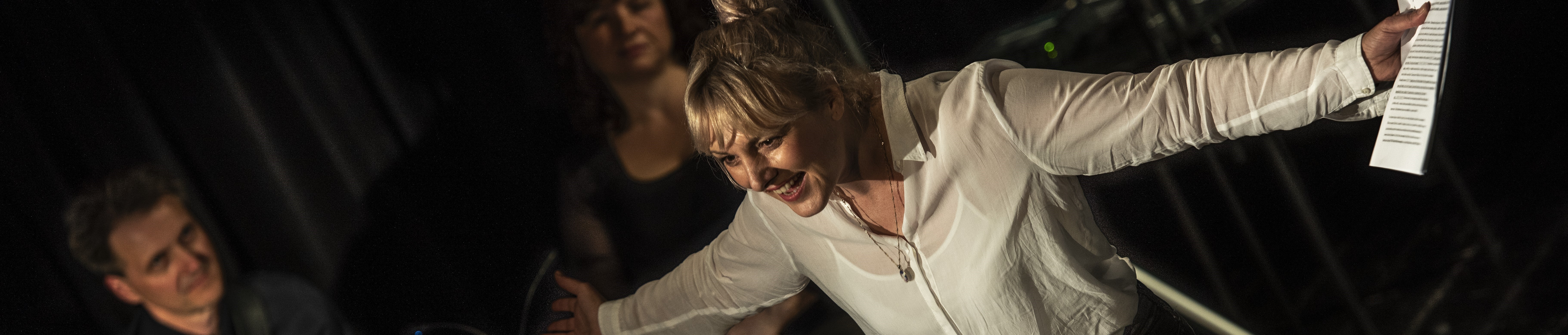


Gelsomina in the World of Children / Pure Play
“When something is named, it most likely loses its magic,” Thomas Beachdel, art historian
And because play is in itself a kind of magic—something unnamed—I decided not to define things in “Gelsomina in the World of Children” in pedagogical or any other terms. To leave play as play, in its exposed, pure, and purposeless form. In the present moment, in our lessons. Without explanations, without labels. Gelsomina is my grotesque character from Fellini’s film La Strada, into which I sometimes transform among the children. And we play. We let things flow as they come. Whatever appears, we play with it. In this column, we will bring you records of our play with children. The rest is up to you.
Gelsomina’s arrival
Gelsomina se objevila znenadání. V dlouhém šedém plášti, s nakřivo nasazenou trpasličí čepicí a rozpačitým pohledem. Zaklepala na dveře studia Mana a vstoupila. Děti zůstaly stát. Gelsomina je pozorovala. V jejich očích četla nedůvěru: „Kdo to je? Můžeme jí věřit? Hraje si s námi, nebo nás zkouší?“ Gelsomina se chtěla pouze zkamarádit, zablbnout a zahrát si s dětmi. Milovala totiž hru a věděla, že děti taky milují hru, a tak se rozhodla navštívit děti v Maně. V divadle je totiž svět, po kterém Gelsomina i děti toužili. Svět fantazie, věcí nemožných, smíchu i radosti. Svět, který nevidíme, ale máme ji v našich duších, hlavách, srdcích, myšlenkách, kde je možné vše, ale to vše je zároveň bezpečné a nedotknutelné. Ohraničené zářícím světelným kruhem, který vidí jen lidi, kteří si hrají. Svět, kde padáte, ale nespadnete, kde kloužete, ale nesklouznete, kde smutníte, ale není vám smutno. V divadle neexistuje nic, čeho by se nebylo možné dotknout a neexistovalo by. Svět fantazie, který je pravdivější a zároveň bezpečnější než reálný svět.
Gelsomina decided to get straight to the point. She stood in the middle of the room. The children sat down and waited tensely for what would happen next. Gelsomina searched in the pockets of her large coat and finally pulled out a piece of paper with relief. She looked at it triumphantly, smiled, and was about to read the first sentence. But the paper was blank. She turned it over. The other side was blank too. Completely confused and uncertain, she stood in the middle of the room, not knowing what to do. Karmenka smiled at her. Gelsomina melted and winked back at Karmenka. Karmenka tiptoed over to her, and Gelsomina whispered something to her—apparently something very important. Karmenka then signaled to the other children that they should stand up and that she had a message for them. She whispered something to them too, and the children ran to get another sheet of paper. They rummaged in Gelsomina’s bag until they found a written page and handed it to her. Among the children, Gelsomina was gaining courage. Just as she was about to read the first sentence, they heard the buzzing of a fly. Bzzzz. Cecilka, Chris, Meda, Eli, Laura, Kája, Jeník, Ines, Esterka, Mia, Zlatka, and Karmenka began to chase the fly. They wanted to catch it and scold it for disturbing Gelsomina’s speech, because they were afraid she might lose her courage again.
In the end, everything fell silent, and Cecilka triumphantly showed the others her clenched fist. From inside it, a sound could be heard: bzzz. Cecilka had caught the fly. The children and Gelsomina began to clap, laugh, and sing: “Gelsomina, Gelsomina…”
Suddenly the bubble burst and Gelsomina vanished. Her coat, dwarf cap, and even the fly disappeared. But the children did not forget her. The following week they asked: “Shall we play Gelsomina again?” That day Gelsomina did not come, but everyone knew she would return again someday. They just had to be very patient. Gelsomina always arrives unexpectedly. She appears like a star in the night sky—like the magic of play that comes from somewhere, turns everything upside down, disappears, and then suddenly reappears.
Erika and the children from Rarach
JWhat is Gelsomina like according to the children from Rarach (aged 7–9)? And what would they like to tell her?
Gelsomina is kind and nice, and in the theatre Gelsomina will be Erika. But that is a secret for the audience. And I would tell her that I like her, that I really enjoy drama classes, and that it is great there.
Kája
A crazy lady. That’s hard. She is just… just crazy.
Cecilka
No, pro mě znamená Gelsomina to, že tu postavu hraje Erika. Takže pro Eriku to něco znamená a má tu postavu ráda. Chtěla bych Gelsomině vzkázat, že má originální styl a že má hezký ten styl.
Ines
Gelsomina is really crazy, and she always forgets everything and tries to squeeze herself everywhere. She’s just always very rushed and impulsive. I would like to tell Gelsomina to calm down a little, and to finally have her text the right way up.
Mia
Gelsomina is very shy. She looks nice. She has a hood and always does something wrong. And I would tell her: You are very shy, but good. Sometimes you make funny jokes.
Jeník
Chris: Gelsomina is shy as an actress and she always does something wrong—she just can’t get it right. She keeps trying, and it still doesn’t work. She is a very shy actress. Meda: When there is a performance, she messes it up every time. (Message to Gelsomina:) Chris: I hope you’ll manage it next time. Meda: And try really hard.
Twins Chris and Meda