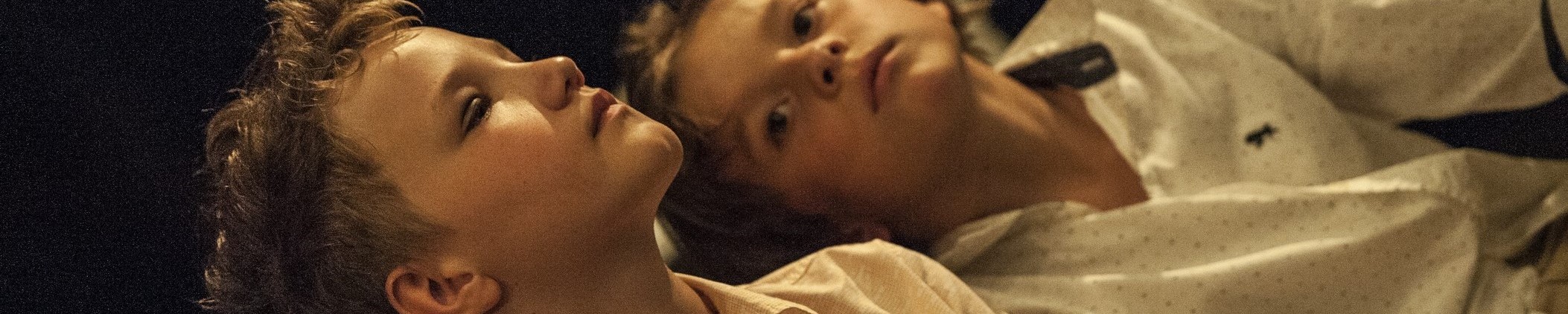


This time with our alumna, Bětka Dolečková, a student of dramatic acting at DAMU.
I want to continue discovering how far I can be free.
Bětka is in her second year of studying dramatic acting at DAMU. She attended TALENT for 14 years. She started as a four-year-old child and went through our entire development, from a traditional drama club to authorial creation. I admired her determination, resilience, laughter, positive energy, humility, and inner purity.
Bětka, do you remember the first moments of our meeting?
I remember. We were working on The Seven Ravens. In the room there was a pink plastic IKEA table with thick legs. There were stairs, a back room, and mirrors everywhere. Parents were sitting there watching us run around the table and caw like crows.
How did you get into drama club?
I didn’t really know whether I wanted to do it. I just loved people, I liked being the centre of attention, and I enjoyed when people were looking at me. I guess that’s why my parents put me in a drama club. Not long ago my mum told me that she thought she was just enrolling me in a drama club I might enjoy. She never expected it could lead to where I am now.
What made you stay with theatre?
Do you think it will sound bad if I say you? I never once thought, when I was with you, that I would stop doing this. Only later, towards the end, did I start wondering whether authorial creation was really for me—whether it was truly what I wanted from theatre.
Maybe it’s simply that it was always in you—you loved theatre. And it just so happened that we met and we offered it to you. What exactly were you trying to figure out about authorial creation?
I have always enjoyed freedom in authorial performances. That was when I began to perceive theatre more deeply. When I was thirteen and we started doing authorial creation at TALENT, our first original performance was based on Krabat. I felt a sense of creative freedom in it. Whoever I created in my mind, I could then bring onto the stage. I liked it so much that I started thinking: I want to keep discovering how far and to what extent I can be free. I was completely absorbed by the freedom and creative thinking I didn’t even know I had in me. Suddenly I discovered I could do things I had thought I couldn’t.
How has authorial creation influenced your studies in dramatic acting?
Many people think that in dramatic acting you have a fixed text, fixed characters, and a director who tells you exactly what to do down to the last detail. But that is not true. If you do not bring a creative atmosphere, a creative spirit, ideas, and a willingness to invest time and yourself into it, you will not create a convincing character. Authorial creation helped me with this. Before, I didn’t know that I could create on my own—I didn’t believe in myself. Then, suddenly, we started creating at TALENT, and I began to go deeper into things, to create, and I discovered that I too can bring something into the creative process that is taken seriously and can be performed. Even in dramatic acting, this creative process is essential. If you don’t put yourself into it, your own motivation, it doesn’t have to turn out well. Relying only on someone saying “act this!” and you simply acting it out doesn’t work. That’s not how it works. There is freedom in being able to slightly shape it, create it, play with it. For me, it is important to know that I can. And I discovered that thanks to authorial creation—that I can, and that I am able.
What about Dialogical Acting, which we do in our programme?
You and space. Until I started studying, I had no idea how important it is. At TALENT, I loved it when I stood in Dialogical Acting in the space and you immediately recognised that I had prepared something in advance (even though it is not supposed to be prepared beforehand, as you once noted). You said: “Běta, just exist in the space, don’t prepare it.” And I said: “But I didn’t prepare anything.” And then I would sit on a chair for half an hour and replay in my head: “Okay, now I will do this and this.” When I connect Dialogical Acting with what I am doing at school, it is about existing in space—my body, perception, attitude. Learning that when my hand makes a certain gesture, it has an impact on the character I am portraying. I understand Dialogical Acting as an opportunity to explore my body—what it can do, what it expresses about a character. When my body starts moving in space and I begin to observe it, I discover what it does, and I can transfer that onto the stage. Then I ask myself: Would my character do this? Or what would they do?
I really like how you talk about exploration.
Exploration is about the fact that a person can. I only started working with this at the end of my second semester exams last year. In my first semester at DAMU, I was completely overwhelmed and had no idea what was going on. Only in the second semester did I realise that I was actually exploring myself. Now it is very important to me, whenever there is space for it. And at school, that space exists. Then you can be ready to go into theatre and continue working. But the impulse has to come from you. No one can tell you: “Now stand still and explore yourself.” That doesn’t work. You have to want it yourself—to discover and search for different positions and states.
How do you perceive this in children?
They have to want it. When there is a desire, there is also a will for creation and exploration, and then a path appears. But I cannot imagine pushing my child and saying: “Now explore.” If they don’t want to, it would only become a blockage.
How do you awaken interest in a child? Comenius already spoke about this.
When a child is given enough space to explore. I understand parents who enroll their children in a million activities. No one says they have to do them for the rest of their lives. But when a child discovers a desire, the parent can support it. The child will say: “I enjoy this.” A parent can give a gentle push, but the decision must be the child’s own. A child will definitely find its place somewhere if the parent gives it freedom. The freedom to want.
So parents should listen.
Definitely. Simply observe the child. Whether they draw along a line, or play with rhythm-based things. Watch what they do every day, instead of constantly pushing them and saying: “Here, take a piece of paper and draw.” Look at whether they sit down by themselves, pick up pencils, and start drawing. As a child, I played with dolls all the time—I would sit at a dollhouse with Barbies, play family, use puppets, play mother, kitchen, restaurant.
Do you think that dramatic work focused on self-knowledge should be the basis of education?
Authorial creation was very beneficial for me during adolescence. It helped me get to know myself. I didn’t go through it as a child—we weren’t doing it at TALENT back then—so I can’t compare. But most importantly, children should keep everything—texts, recordings. I hope you are telling them that. Because one day, when they are forty, they will sit down with a box, open it, and see everything they wrote as children, who they were. I would give anything to be able to see what I was like at four years old.
Do you think a person’s personality and an actor’s personality are connected?
For me, they complement each other—the personality of the actor and the personality of the person. An example is our teacher Ondra Vetchý, who tells us that what matters most is what kind of people we are, not so much what kind of actors we are.
Can’t a person be such a good actor that they are even able to perform being a good human being?
They would probably have to convince themselves first. But at some point, it has to break. You cannot constantly be on guard, monitoring what you say, when, and where. I don’t know if anyone can do that. I couldn’t.
Do you remember the play you enjoyed the most with us?
I loved the performance where we played emotions. It was called Eliška. And then Five Sides of My Self, which we performed at Vzlet. In Eliška, I was about 15 years old, and we could choose which emotion we would represent. I chose love. I put all my emotions into it, everything I had from the position of love. It fulfilled me, like a personal diary. I remember how Inka played Trust in the performance and led Eliška up the stairs with a blindfold, so she couldn’t see anything. Inka, as Trust, told her: “You can trust me.” And as she guided her down the stairs, Eliška fell. These kinds of moments stay with you.
And Five Sides of My Self?
It was also the first project with people who wanted to do theatre in the same way I did. They were genuinely passionate about it, they wanted to commit to it, attend rehearsals regularly, and create. I remember our discussions. After Covid, before the holidays, we sat outside on the grass and talked about what interested us, what each of us had been doing during Covid, until we arrived at something we wanted to stage. It happened quite suddenly—it emerged. The entire rehearsal process and the performance itself arose naturally, without pressure, almost spontaneously. We then formed a group under TALENT called Vosí hnízdo (Wasp Nest) and tried performing the piece repeatedly. Covid interrupted our rehearsals. We met online, and yet it held together. Even though for some people it could have been demotivating—I can imagine someone giving up because meeting for acting every Thursday for two hours on camera was difficult. But we all stayed with it. We endured it. We wanted to see it through, to have a shared goal and a shared project.
What do you think is the most important thing for someone who wants to study acting
Not to have ambitions of becoming a big or famous actor, but to present yourself to the audition panel as you truly are. Not to pretend, and not to have prejudices like thinking you can’t do something—such as singing—and therefore shouldn’t apply. To trust yourself, and also trust the admissions panel. If you feel you have something inside you, then show it. My message would be: trust yourself, and trust them. They also trust you to show your best.
What is most important to you in life?
Family, close ones, friends, and environment. My parents helped shape me, and my friends inspire me. The people I move among have a strong influence on who I am.
What is your dream?
To be proud of myself in the future—that I have walked a certain path and that I have not given up. That in difficult moments I did not let myself be pushed into a corner. That I was strong and managed it.
What would you like to tell children who want to become actors?
They should trust the process, their own path, and themselves. And if they want it, they should go for it. If something isn’t there right now, it doesn’t mean it cannot be there in half a year or a year. Sometimes it arrives all at once. I trusted you, and now I trust my teachers to help me get there. And I also trust myself. Right now I struggle with singing. My singing teacher tells me: you already have it there, you just need to start believing in yourself. And I believe that I will get there one day. The only question is when.
What do you think made you stand out to the DAMU admissions panel?
Probably my personality. That I was a bit wild and spontaneous. I came in front of them as I am, saying: this is who I am, and I want to show you the best I can do. I am hardworking, I want to keep developing, and I want to show you that. I think they appreciated my diligence and work ethic.
What did TALENT give you for your acting studies?
The freedom to learn how to create, creative thinking, and discovering what is inside me. Also, what theatre is about—its forms and possibilities.
What makes a good teacher?
They are understanding, tolerant, and accommodating. They know what they are doing. They don’t say “this is how it is,” but instead try to lead the person to discover it themselves. And above all, they teach with heart.
In which projects can we see you?
In collaboration with the school, we have a production called Kitchen at the Prague City Theatres, directed by Michal Dočekal, who is also a teacher of our directors. In addition, I filmed Sweet Life by Tomáš Hoffman in September, which premiered in March. And I am about to start rehearsals for the National Theatre at the Estates Theatre, based on the novel White Water by Kateřina Tučková.
What would you say to children at the end?
When I was going to the DAMU entrance exams, I kept asking myself: why me, out of 360 applicants, should I be accepted? But anyone can. Everyone has the same chance. I would tell children not to let fear push them away, to trust themselves. Whether it is any school or any dream. We all have the same chances—so let’s go after it.
Thank you for the interview.
Erika Merjavá