
This time with Isabella Petzold, who attended our programme for seven years. She is now studying Film, Theatre and Media Studies in Frankfurt am Main, with Political Science as a minor.
Kindness and respect are things we can all afford. There is no excuse for not having them—no circumstance justifies it.
Iza pochází z česko-německé rodiny. Je usměvavá, empatická a zvídavá. Disponuje velkou vnitřní silou a energií. Miluje Frankfurt, divadlo a lidi. Ráda jezdí za babičkou a dědou na Moravu, ale taky se zajímá o politiku a svět. V rozhovoru mě zajímal nejen dopad Talentu na její osobnost a život, ale i politická témata – jako studentku politologie, její pohled na současné Německo a to, kde vnímá pevný bod člověka v současném složitém světě.
Izo, you are studying in Germany. Why these subjects, and why in Germany?
I see my personality reflected in it very clearly. I have always moved between my love for theatre and film, and at the same time I have been interested in politics. So I was looking for something where I could combine all my interests and passions. In the end, I found a university in Frankfurt. And as you know, I am German through my father, so I have always had a close connection to German culture and language. But I had never actually experienced living in Germany. So getting to know the country itself was my main motivation.
What is contemporary Germany like?
It is too big to describe easily. My bubble in Frankfurt am Main, which is an international and multicultural city, is a good one. I am lucky to be surrounded by people who grew up there, so I didn’t end up in an international student bubble. What surprised me is how countries and life within them cannot be simply compared as better or worse, or more progressive and more backward. We often compare countries and say: these are progressive, these are behind. Some things in Germany are much more established than in the Czech Republic—for example, when it comes to feminism. I sit with my friends and they explain why quotas for women in leadership positions are important. On the other hand, I was surprised by a certain backwardness in some areas. Here, not much is online—everything is done by post or in person at offices, and the internet coverage can be poor.
Would you recommend that young people study abroad?
Definitely. You meet different people and different perspectives. You can read as many books as you want about a region, but until you actually talk to the people who live there, you won’t truly understand it. As someone coming from a post-communist country and studying political science, I experienced a cultural shock. I realized, for example, that because they don’t carry the same historical trauma as we do, they can have a completely different approach to things like Marxist theory. So when you go abroad, you learn to confront different environments and historical experiences than the ones you come from.
It enriches a person when two worlds and two different experiences meet. It shakes you up, the blinders fall away, and experience is rearranged again.
Yes. You come into a dialogue with a different set of experiences. And even though we are similar at school, because we are people with similar interests, suddenly there are small details that reveal differences in how we perceive things. In Germany, I have many friends who, like me, come from bilingual families. Through them I get to know other cultures—I don’t even have to travel to experience them. It made me realize how strongly I was shaped by where I grew up. In general, I think that talking to people is the most valuable thing. You learn so much. It’s simply about having curiosity in yourself.
As students of political science, how do you view the current geopolitical situation?
Paradoxically, since I started studying political science and as dramatic things are happening in the world, I find myself increasingly distancing from it. Because I don’t really know what to do with all of it or how to approach it. People are more conservative, more liberal, or positioned within different currents. At our campus there were many protests expressing solidarity with Gaza. Everything was peaceful; the aim was simply to show a different perspective. With Ukraine, there is a strong consensus—it is supported and seen as important for us. We are interested in everything that is happening in these conflicts.
What is the situation with the disinformation scene in Germany? And how is German society divided?
In everyday life, societal polarization is not very visible. But of course, if you look at the results of the February elections to the Bundestag, the AfD had an incredible result. For example, yesterday I was at a work event and suddenly a colleague of mine—someone from a completely different generation, also Czech—said she felt like she couldn’t express what she really thinks. But when she explained her argument, the views she felt unable to express were in fact directed in a way that was offensive toward certain groups of people. So I didn’t really understand her argument, because of course you can express your opinion, but you also have to accept that other people may not find it acceptable.
Why do you think there is currently such a rise in extremism, fascism, racism, and nationalism?
I ask myself this question very often, and I don’t have a clear answer. Maybe in post-communist countries like the Czech Republic, we were carried away by the euphoria of freedom and thought that everything would now be perfect. We ignored decades of real problems that people are now frustrated about—which is understandable. Social media also plays a major role, as does the interconnectedness of the world, algorithms, and the extreme development of political marketing. Political parties are much more capable of working with large groups of people. This makes me wonder whether we should focus more on small, concrete things rather than trying to answer the big question of how we ended up here.
When I interviewed Lada, it felt similar to you. All her interests came together in her studies of child psychology—just like in your case.
For me, it was important to pursue something I would enjoy—something where I could unite all parts of my personality—rather than something that would simply be useful for me.
You perform in an amateur theatre group in English. What led you to that?
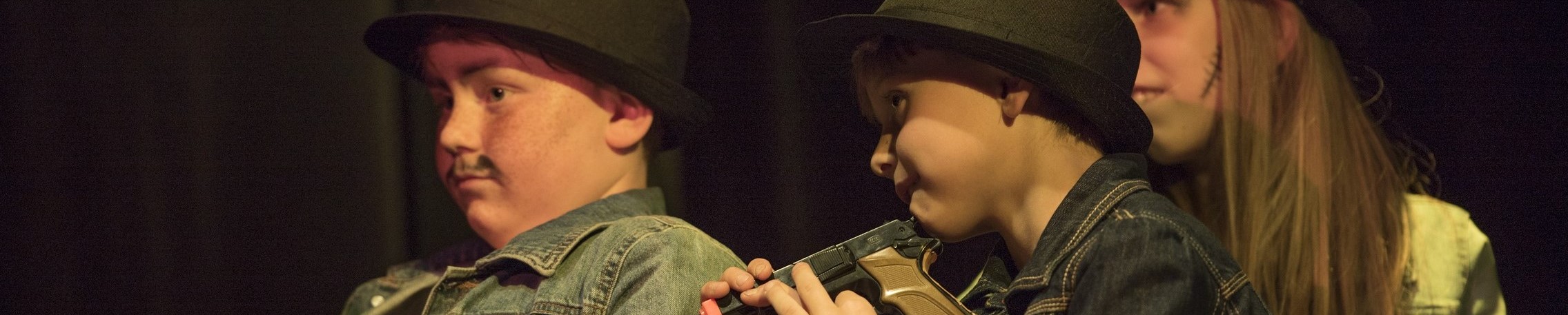
When I came to TALENT at the age of ten, I confirmed my intuition that acting, the stage, and theatre were something wonderful. I fell in love with it, and when I left, I knew that theatre would have to remain part of my life in some form. When I started studying in Frankfurt, I discovered that there was a theatre group under the Institute of English and American Studies. I went to the audition, and it was amazing. What I love about theatre is many things. I meet all kinds of specific people there. You create a kind of closeness with them, and yet you don’t really know that much about them. Communication and meeting people in theatre happens on a different level—deeper, more internal. I also love being on stage—the adrenaline when you step out, the joy and euphoria at the curtain call, when you feel: we did it. I love the creative process, the chance to work with the audience, or with silence and tension. When I have theatre in my life, I am more proactive, I have more energy, I can release emotions, and they don’t accumulate in my head and cause trouble.
How do you work theatrically within the ensemble?
For me, it was a new experience that in the English-speaking ensemble we work in a more traditional theatre way. You have a text, and the director has a clear vision. There is nothing devised or author-driven about it. For me, it was a very different experience compared to TALENT, where everything always came from us.
How do you perceive the difference for yourself between the devised theatre you experienced with us and what you are doing now?
Devised theatre allowed me to do classical theatre. For me, the form of theatre you offered us at that moment in my life was essential for my personal development. I see it as a stage before and a stage after drama classes. It brought me many things beyond theatre as well. In that sense, it can be meaningful even for people who don’t necessarily want to do theatre, but are searching for themselves or for something in general. Devised creation has an overlap—it offers you much more than theatre alone. And at the same time, you learn a great deal about theatre itself. I can see how much it has helped me even in more classical formats. If it had been the other way around and I had started with classical theatre, I think I would have developed completely differently.
For me, devised theatre as I experienced it with us is a form of pedagogy—a way of opening up and developing personalities and potential, a path to self-knowledge. In the end, each person decides for themselves what they are drawn to. But in any case, they learn to be creative.
In TALENT, we really created our own performances. It wasn’t just about acting—you could see the whole process of building a piece, making sure it had structure, coherence, rhythm, and pace. You were exposed to many different areas of creation, which at that age is very valuable, because people can get a taste of many things and then decide what they want to focus on. In TALENT, it was our collective work, a shared creation. There was no hierarchy. You can’t blame anyone for anything. You are all in it together, creating and carrying something collectively.
How did creating in TALENT specifically influence you?
It accelerated many things that I would otherwise have had to discover over a much longer period of time—parts of my personality that might have taken me ten years to realize I even have. It opened me up a lot and gave me a sense of control over myself and my life—that I hold the reins of my own existence, that I am not just a passive observer, but an active participant. You learn to use your voice, to sit in a room, to talk to people, to be present in a situation. TALENT helped me let my personality come to the surface and actually live it—not keep it hidden away, waiting for perfect conditions to show itself. Instead, to live it fully in all conditions. It gave me a love for communication—with people, in front of people, and in creation. Paradoxically, in TALENT there was a very comfortable form of constantly stepping out of your comfort zone. It felt safe. At the same time, you do things you would never think you would do in life. And then suddenly you realize: I can do this. I am capable of this—and I even enjoy it.
What about you and Dialogical Acting?
I will never forget it. I wouldn’t say I understood it then, or that I fully understand it now. But I experienced everything we did as a whole. I had a sense that it all worked together, and that’s what I enjoyed about it—that even if I didn’t fully understand what I was doing in a given moment, I knew that somehow it made sense in relation to everything else.
What does joy mean to you?
Joy, for me, is everyday positivity. It doesn’t have to be something big—it’s simply feeling well. A sense of calm in the moment I am experiencing.
Where does it come from for you?
I have always had a good family background. That gives me a certain level of comfort, inner calm, a solid base that doesn’t let me fall too deep into sadness. Then I need people around me, interaction with them. And also to see that what I do has some impact—how I behave, what I create.
Do you think a stable inner foundation is innate, or something we develop over time?
It’s probably a combination of several things. I am definitely a person who tends toward positivity and joy. That might also be why I love theatre. I love fiction, building castles in the air, the Disney-like happy end. I can dream, float in the clouds. But it is also clearly shaped by my family background and the people who have surrounded me.
Where do you find meaning in life?
Maybe in greater simplicity. To have a life that I like, and to try to enable others to have that as well. So that we all manage as well as possible. Otherwise life doesn’t make sense. Why do I have this, why am I doing well, why do I have one problem and not another? You can’t find logic in it. Whenever you try to impose logic on it, it quickly becomes dangerous, because you create some harsh theory or ideology that you then apply to people—and that always goes wrong. I want to be a positive player in life, not a negative one.
That reminds me of Pope Francis, when he visited prisons: “Why him, why not me?”
We create plans and ideas of how the world should look. But the world is never like that. It changes six times before we reach a goal. It is not a clear, planned path that leads us to being happy, satisfied, healthy, and financially secure. That’s why it may be better to focus on smaller things. I feel that as people we often get excited about a direction, and then when it doesn’t work out, we roll back down the hill. Of course, it is natural that we are all looking for something to rely on, something that works. But nothing will probably ever work exactly as we plan it. There is a lot of randomness in it.
What is your compass in life? What do you base your decisions on?
My own interest and enthusiasm. Because then I will do it sincerely.
What do freedom and boundaries mean to you?
When I don’t know where the boundary is, I rely on kindness and respect between one human being and another. When I was a child, it felt clearer to me. I had a stronger sense of what is good and what is bad. Now I miss that a little. When I look at what is happening in the world today, I miss a clear line of what I can stand for, what I can support, where freedom ends and where limits are being crossed. It feels confusing. Where is the boundary in today’s world? Who is on the right side and who is on the wrong side? I don’t know. I only know that a lot of people are paying a very heavy price for it—and I don’t know what to do with that. What my role is in this free world.
The world today is extremely complicated. A person can easily get lost in it.
I cannot resolve the conflict in the Middle East, climate change, the consequences of globalization and capitalism, or authoritarian regimes. I can only look for something manageable for myself—something I can actually hold on to. For me, that is found in everyday interactions with people I don’t know, in interpersonal relationships. Those are strong moments that help me orient myself. In chaos, I try to find some order, something to grasp. Because kindness and respect are things we can all afford, and there is no excuse for not having them—no circumstance justifies it.
That reminds me a bit of the philosophy of Tomáš Halík, who tries to create dialogue and connect people.
Ideas and versions of a better world change constantly, and so many people have sincerely tried to invent a better world—only to end up causing even greater horrors in the process. We don’t know what an ideal world is. But we can all be kind to each other, and even in conflict, try to preserve our humanity.
Thank you for the interview.
Erika Merjavá