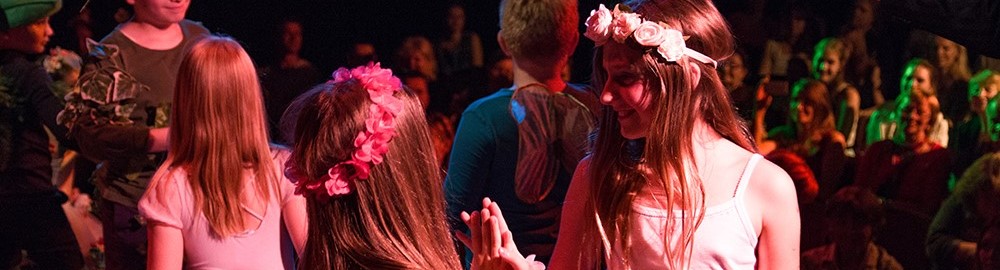


Gelsomina is a character created in the TALENT studio.
Gradually, she became part of the shared work with younger children. The children accepted her, began to communicate with her, enter her stories, and further develop them. This created a living relationship that is constantly evolving. So much so that children aged 8–11 themselves suggested renaming their group to “Gelsomiňáci”. Gelsomina is not a finished character. She is a process that unfolds in the relationship between imagination, play, and reality.
Below you will find her story – how she appeared and what began to happen around her (published in our Dialog newspaper):
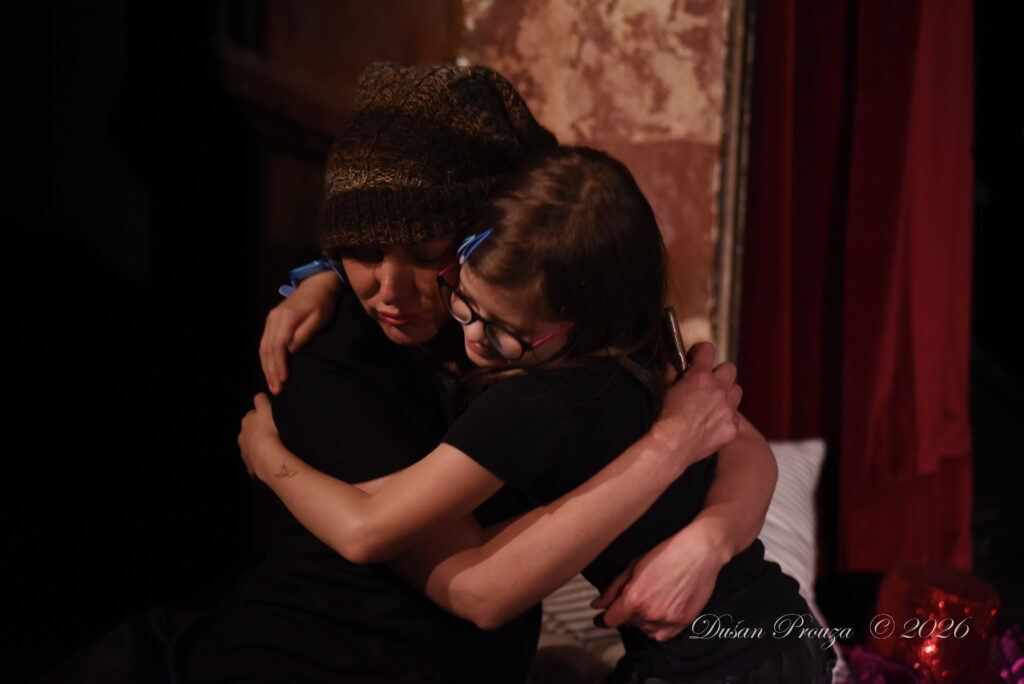
Gelsomina in the World of Children / Pure Play
“When something is named, it most likely loses its magic,” Thomas Beachdel, art historian
And because play is in itself a kind of magic—something unnamed—I decided not to define things in “Gelsomina in the World of Children” in pedagogical or any other terms. To leave play as play, in its exposed, pure, and purposeless form. In the present moment, in our lessons. Without explanations, without labels. Gelsomina is my grotesque character from Fellini’s film La Strada, into which I sometimes transform among the children. And we play. We let things flow as they come. Whatever appears, we play with it. In this column, we will bring you records of our play with children. The rest is up to you.
Gelsomina’s arrival
Gelsomina appeared out of nowhere. In a long grey coat, with a crooked dwarf’s cap and a slightly awkward gaze. She knocked on the door of the Mana studio and entered. The children froze. Gelsomina observed them. In their eyes she could read distrust: “Who is she? Can we trust her? Is she playing with us, or testing us?” Gelsomina only wanted to become friends, fool around, and play with the children. She loved play, and she knew that children love play too, so she decided to visit them at Mana. Because in theatre there is a world that both Gelsomina and the children longed for—a world of imagination, of impossible things, of laughter and joy. A world we do not see, but which lives in our souls, heads, hearts, and thoughts. A world where everything is possible, yet everything is also safe and untouchable. Enclosed by a glowing circle of light visible only to those who play. A world where you fall but do not fall, where you slide but do not slip, where you feel sadness but are not sad. In theatre, there is nothing that cannot be touched and does not exist. A world of imagination that is both more truthful and safer than the real world.
Gelsomina decided to get straight to the point. She stood in the middle of the room. The children sat down and waited tensely for what would happen next. Gelsomina searched in the pockets of her large coat and finally pulled out a piece of paper with relief. She looked at it triumphantly, smiled, and was about to read the first sentence. But the paper was blank. She turned it over. The other side was blank too. Completely confused and uncertain, she stood in the middle of the room, not knowing what to do. Karmenka smiled at her. Gelsomina melted and winked back at Karmenka. Karmenka tiptoed over to her, and Gelsomina whispered something to her—apparently something very important. Karmenka then signaled to the other children that they should stand up and that she had a message for them. She whispered something to them too, and the children ran to get another sheet of paper. They rummaged in Gelsomina’s bag until they found a written page and handed it to her. Among the children, Gelsomina was gaining courage. Just as she was about to read the first sentence, they heard the buzzing of a fly. Bzzzz. Cecilka, Chris, Meda, Eli, Laura, Kája, Jeník, Ines, Esterka, Mia, Zlatka, and Karmenka began to chase the fly. They wanted to catch it and scold it for disturbing Gelsomina’s speech, because they were afraid she might lose her courage again.
In the end, everything fell silent, and Cecilka triumphantly showed the others her clenched fist. From inside it, a sound could be heard: bzzz. Cecilka had caught the fly. The children and Gelsomina began to clap, laugh, and sing: “Gelsomina, Gelsomina…”
Suddenly the bubble burst and Gelsomina vanished. Her coat, dwarf cap, and even the fly disappeared. But the children did not forget her. The following week they asked: “Shall we play Gelsomina again?” That day Gelsomina did not come, but everyone knew she would return again someday. They just had to be very patient. Gelsomina always arrives unexpectedly. She appears like a star in the night sky—like the magic of play that comes from somewhere, turns everything upside down, disappears, and then suddenly reappears.
Erika and the children from Rarach
JWhat is Gelsomina like according to the children from Rarach (aged 7–9)? And what would they like to tell her?
Gelsomina is kind and nice, and in the theatre Gelsomina will be Erika. But that is a secret for the audience. And I would tell her that I like her, that I really enjoy drama classes, and that it is great there.
Kája
A crazy lady. That’s hard. She is just… just crazy.
Cecilka
Well, for me Gelsomina means that the character is played by Erika. So for Erika it means something, and she likes the character. I would like to tell Gelsomina that she has an original style and that her style is very nice.
Ines
Gelsomina is really crazy, and she always forgets everything and tries to squeeze herself everywhere. She’s just always very rushed and impulsive. I would like to tell Gelsomina to calm down a little, and to finally have her text the right way up.
Mia
Gelsomina is very shy. She looks nice. She has a hood and always does something wrong. And I would tell her: You are very shy, but good. Sometimes you make funny jokes.
Jeník
Chris: Gelsomina is shy as an actress, and she always does something wrong, and it just never works for her. She keeps trying, but it still doesn’t work. She is a very shy actress. Meda: When there is a performance, she messes it up every time. (Message to Gelsomina:) Chris: I hope it will go better for you later. Meda: And try really hard.
Twins Chris and Meda