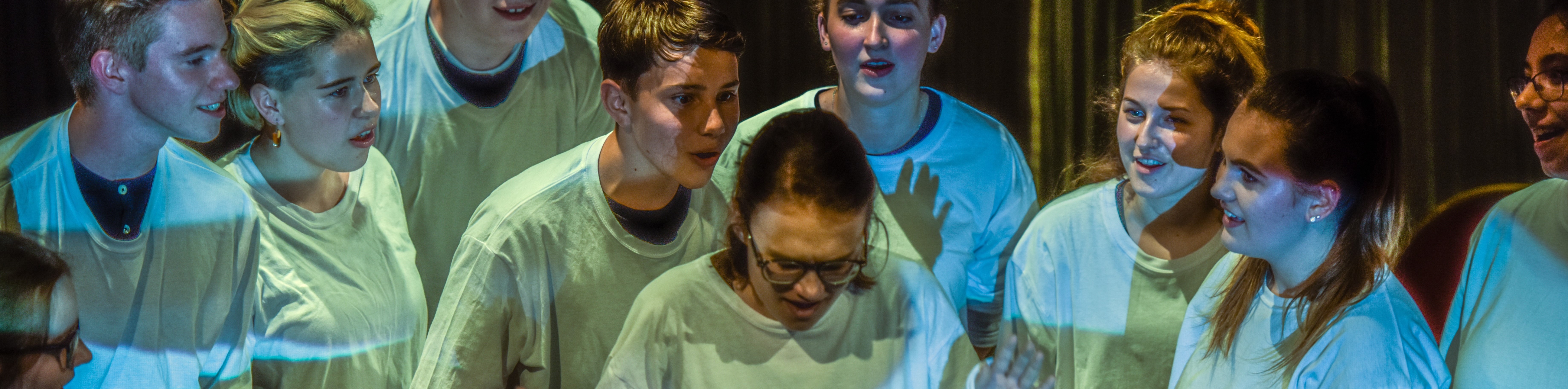


Ríša is a young person with a remarkable talent for improvisation, who has been attending Talent for two years. When I first saw him improvise, I watched him in amazement. His playing was free of all ornament, ambition, pretence, and performative display. Just pure play and existence—freedom and humour. A raw, full presence in the space of play. Grounded and focused.
When did you first feel the need to play in your childhood?
In fourth grade. We had a subject called drama education. Once, for the 25th anniversary of the school, our teacher asked whether we would like to create a class project. We created a performance in which we brought the classroom to life. We imagined what the things in the classroom think, how they perceive what is happening around them. The desks, bags, and pencil cases spoke. I enjoyed being able to express emotions—I didn’t have to keep them to myself. At that time, I didn’t know what to do with myself. That pulled me out of it.
What do fixed texts mean to you versus creative freedom?
“I only understood it this year. Last year I was really lost in it. This year, a fixed text has started to feel for me like a kind of bridge…
Bridge?
A bridge, a structure you walk across. You know where you are going—from one shore to the other. There are twists and turns, but the direction is clear. When I used to work with improvisation, I was often in an undefined cloud. Only this year did I realise that when a person has a solid structure, a clearly defined text—possibly one they have written themselves—it is like learning technical procedures in school. And when you place a cloud of your creative acting inside that structure, the bridge becomes airy.
Do you approach things on stage in a deliberate, thought-through way, or do they lead you on their own?
Sometimes the stage itself directs me. In the auditorium, nothing comes to mind, but the moment I walk up the three steps onto the stage, something suddenly switches in my head, like a valve, and I start thinking completely differently. Suddenly it’s there. When I stand in front of people, I enjoy their gaze, looking into their eyes. From their eyes I catch some thought of theirs, something I can then play with, develop, open up. It already happens on a subconscious level. It leads me.
You are a trained plumber and you are training as a chimney sweep. Why these professions? How do they work together with theatre?
In ninth grade, during our practical classes when we were making a wooden holder for sandpaper, I got drawn to manual work. At that time, I wanted to become a paramedic, to drive around in an ambulance and deal with situations spontaneously. Even during COVID, at the end of primary school, I translated that into theatre—a scene performed over an online meeting. I got myself headphones like a dispatcher and played an emergency call operator in online theatre. When the microphones came on, it felt authentic. Or I would imagine sitting in an ambulance and hearing a call from dispatch: ‘Unit 105, we’re here. You need to go to this and that street, there is a man with this and that problem.
How did you go from wanting to become a paramedic to becoming a plumber?
While I was filling out applications for secondary school, I didn’t know what other field to choose besides health-related schools, or what else to pick in case I wasn’t accepted. The first thing that came to mind was gardening. If I didn’t get into my first or second choice, I would become a gardener. My first thought was: okay, calm, outdoors, everything nice. But at an open day I realised I didn’t enjoy it. First, I have allergies to pollen and dust, and second, I don’t like delicate, precise work. Then carpentry came up—working with wood. It’s nice, but it didn’t speak to me. Then my mum said: what about plumbing? The first time I saw a plumber was when someone came to repair our boiler—and they fixed it in such a way that two days later our place was flooded. I thought: these are people who don’t really know what they’re doing. And then, five hours later, our bathroom drain got clogged. My mum said: can you fix it? I struggled with it for about two hours, and in the end I cleaned it and the water started flowing again. And I enjoyed it. It started to fascinate me. Before that, I thought you had to study, get a high school diploma, then university, end up in an office. I had already accepted that I would maybe do some manual work at home at best, and otherwise I’d be stuck in some office on the ninth floor, it would be hot there, and by fifty I’d have a big belly, be lazy as a louse, and resent the whole world. Learning the trade opened my eyes. When I reached my third year, I started thinking: what am I going to study next? I’m just a plumber with a vocational certificate—nothing more. Everyone around me was talking about follow-up studies and diplomas, but I didn’t want to take the exams yet. I wanted to study, enjoy life a bit more, and only then finish school and work. So I applied for chimney sweeping. I thought it was similar to plumbing—just instead of water, there are fumes. I didn’t know anything about it. I had only seen a chimney sweep once in my life. I thought: they just clean chimneys. It felt like beautifully dirty work. And when I cleaned my first chimney, it smelled wonderful—exactly like in villages. Then our instructor explained that this is how wood smells, how coal, mazut, and petrol smell. I realised I was basically ‘tasting’ soot. Not only wine can be tasted—soot and smoke can be tasted too. Do you know why chimney sweeps are said to bring luck? Because when a chimney sweep came to a village and cleaned the chimney, the ‘red rooster’—meaning fire—didn’t come, so the house and the whole village didn’t burn down. Or there is a legend from the time of Maria Theresa. When chimney sweeps cleaned chimneys, which were large enough for a person to climb into, one of them came to Maria Theresa after finishing his work. She asked him whether he had cleaned the chimney properly. He said yes. She touched him to check if he was telling the truth—and because chimney sweeps don’t lie, her glove turned black from soot. And she said: ‘You are indeed lucky.’
How do you see the connection between your vocational training and theatre and creative work?
It fits together nicely. Craftsmen are serious—they look serious while working, and serious when dealing with customers. The whole day is serious. I needed to lighten that. A craftsman has to behave properly in front of customers, but at the same time, when something doesn’t work, he gets angry—but he must not show it. Then again, there is the euphoria when things start to work… I found that quite comical. That a person changes emotions like socks. Like drawers you open and close. And when you are doing something, almost all of them are open at once. That is theatre. You keep switching all the time. And then you start laughing at yourself. That is actually the best part of it.
Such a game.
When I don’t play with life, I don’t enjoy it. It becomes cyclical and routine. But when a person plays, every day is different. We often feel that we have a routine life. But if we broke it down into small parts, we would realise it is not routine at all—that we are constantly playing a different game. It is like playing billiards. Every ball goes somewhere different, but the core is life itself. The game flows and the ball rolls. You can let it be if you feel it is becoming repetitive, or you can open up the game again.
In the performance I, you played a stove maker—a craftsman. During a post-performance discussion, someone from the audience asked how you liked the character of the stove maker. Ty jsi odpověděl, že spousta lidí si myslí, že lidi, co pracují manuálně, jsou hloupí. A že tou rolí ukazuješ, že to není pravda. Že ten nejméně nápadný člověk, kterým ostatní opovrhovali, byl zrcadlem všech ostatních. Takový archetyp moudrého starce.
My master and my grandfather are exactly the kind of people I was playing. There are many people like them. With chimney sweeps, for example, people see only the shell—a person covered in soot or tar. But if they looked inside, they would see much more: perhaps a flourishing tree full of wisdom and experience that can be passed on to others. In general, people tend to look at others only from one angle. They don’t see the full complexity of a person.
Do you think these are our stereotypes?
Either it is a personal stereotype, or people simply don’t want to see it.
Why?
It is either the ego or the roles in which communication between people takes place. For example, in a customer–shop assistant position. The shop assistant doesn’t need to know what the customer has inside, what they live by. They only talk about the price, the customer pays, the assistant gives them the goods, and then it’s goodbye—thank you. But if the shop assistant asks the customer something, communication starts to unfold. They begin to learn something about the customer. And the customer learns something about the shop assistant.
What does communication mean to you?
Inspiration. Like the opposite poles of a magnet—plus and minus. They attract each other. When a person looks into another person’s eyes, it is an impulse. Eyes radiate a certain energy. Or when someone starts talking, sharing their experiences and perspectives, something can emerge from that. When people communicate too little, it becomes grey. One asks: ‘How are you?’ and the other answers: ‘Fine.’ That says nothing. But when a person truly talks about how they are, communication unfolds. You start learning something new. If everything were handled through communication, people would sit together, listen to each other—even different opinions—and many things would be resolved.
What does life mean to you?
How one lives it—through work, free time, experiences, family, and friends. Everything comes together into one: that I enjoy living and being here. I cannot give priority to one thing over another, because they are all reasons why I live. Without family, I would have no support and no one to share many things with. Without work, I would not clear my head from family life. Without acting, I would not be myself. Without mountains, I would not see inspiration. Without sailboats and wind, I would not experience freedom. Without music, I would not experience relaxation.
“In connection with the Rozmach group, children aged 13–15, where since March you have been stepping in for a girl who left us. Unfortunately, the performance in the end it didn’t work out, which we all regretted. I am interested in your feelings about the process.
I went into it as another opportunity I could step into—a chance to discover something new and also to help. I didn’t know what would come out of it or what my role would be, but I was very curious. And what did it give me? That many things can change quickly—even in life. From one hour to the next, there was a different opinion; from one person to another, there was a different opinion. As the performance date was approaching and we still had nothing, so it was necessary to fully switch on, I found it funny how people started excusing themselves from attending rehearsals: ‘I’m not coming to the session today.’ I could have created our performance about that: ‘I’m not coming.’
It’s a pity you didn’t suggest it. Maybe the performance would have eventually come into being.
I didn’t want to interfere. I wasn’t a permanent member of the group. What I liked was how, in the middle of the year, everyone had their own little island. Everyone was like Robinson Crusoe. When I joined the group around March, they already had the performance mapped out. I thought: now we’ll start pulling together as one. But the rope slowly started to unravel—strand by strand. Everyone had their own thread, but on their own island. The threads were intertwined only very loosely, so the rope was never whole and we couldn’t really pull it together. Everyone was holding onto their own small thread on their own island, insisting on their own opinion. At one point it looked like we had finally agreed on something. And then the next week—boom—it all fell apart into fragments again. We were back where we started. Like a ship sinking and us ending up in the water again. The first ship sank, we tried to save it, then the second one sank too, and we were back at the beginning. But I still believed it would work out. And then the next week—boom—back into fragments again. I started losing my way as well; everything became foggy. But I still believed and I still saw the performance on stage. Then another week, even more fog, and by the last one I couldn’t see it on stage at all. I thought: it’s gone to pieces.
When was it?
It was an hour before the weekend intensive—two weeks before the performance. I couldn’t see the group on stage anymore. And when I don’t have an inner image of it, it feels wrong. I lost faith that we would actually perform it. Then came the weekend intensive. From our group Vosí hnízdo, Hanka arrived and created a script from their texts—about how the whole year had unfolded, their feelings. I thought: they’ll manage it, at least those twenty minutes. I saw them sitting on chairs, speaking. I was in a state of euphoria. And then came their decision: ‘We are not going to perform it.’ I believed they would change their minds and eventually come to perform at the festival (note: Vršovice Talent Festival). And when I didn’t see them there, it finally clicked that they really wouldn’t perform it. Not anymore. They were missing at the festival. It felt like someone had cut out a piece of film.
Why do you think it turned out this way?
If the parents hadn’t been there—if they hadn’t come to watch them, and the kids hadn’t felt that they would be judged, criticised, or that they might disappoint them—I think they would have come together and performed it. It reminded me of something our instructor once said after a competition: ‘You let yourselves be shaken.’ It was the same situation. We were shaken at the competition, and they were shaken by the parents. After that competition, I told myself I would never let myself be shaken by anyone again.
I’m sorry about it too. It would have been a nice ending to the Saturday, and to their year of work as well. A group of teenagers talking about their feelings that over the course of the process they went through, why the performance didn’t work out. Just darkness and a spotlight. It could have been powerful and inspiring for the audience.
Incredibly so. But every bad experience is also a good experience. A person learns from it, and next time they either won’t do it, or they’ll do it differently.
What is the most important thing in life for you?
Manual work and people.
What are your dreams?
To get my skipper’s licence and set sail on my own boat. I love freedom. And I also like everything that is uniform. Whatever is uniformed is beautiful.
You like letting others shine. Yet you yourself are a distinctive actor.
When someone shines, I feel fulfilled for them. I’m happy that they are happy. In theatre and in personal life. I do everything I can to support them.
And the ensemble you perform with?
Mutual help. Everyone is made of a different dough, we complement each other like a puzzle. Everyone thinks differently, and the fragments of the mosaic come together into a beautiful whole.
What would you say at the end of our conversation to the kids from Rozmach?
Not to get stuck in cycles and thoughts, to keep an open mind for new ideas and things, and to listen to others. They had enormous potential to come up with something. But in creative work, you also have to know when to step back, so that a performance can actually emerge.
Thank you for the interview.
Erika Merjavá