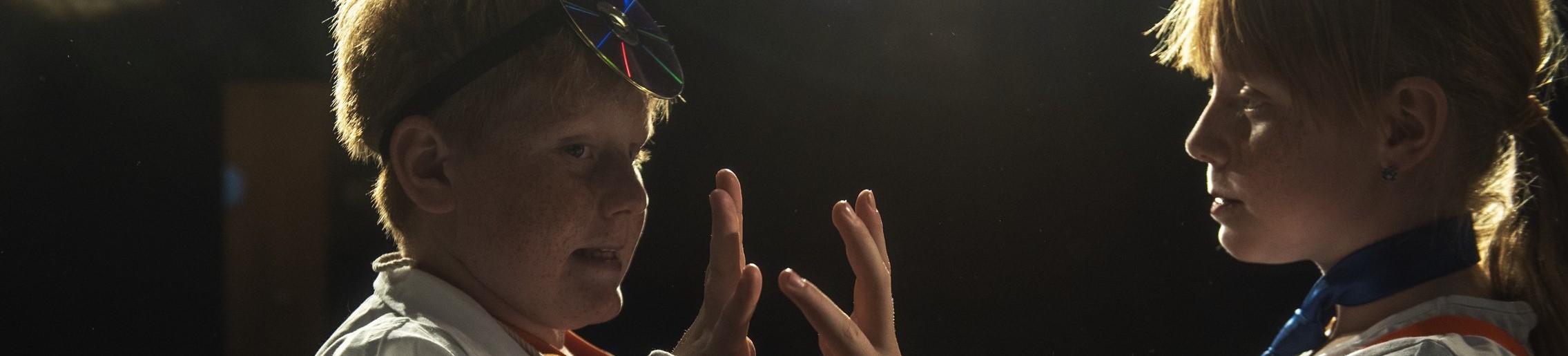


Miracles of Friday Evenings / THEME — CHILDREN
Hana Sršňová and Erika Merjavá, in their shared lyrical-philosophical conversation at a common table at the end of the working week, explore questions of how children perceive the world, Vyskočil’s dramatic pedagogy, and the ways in which children’s perception, education, and drama extend toward adults, society, and the wider world. It is a space full of questions, where small miracles may also appear.
How do children perceive the world?
Children naturally sense that they are still “unfinished,” and because of that they are incredibly humble. Their eyes are constantly wide open—surprised and discovering. They show that they still do not know. They are full of wonder, expectation, and searching. In contrast, adults already have established patterns of behaviour, and it is very difficult to disrupt them. A child, however, is fully open to discovering the world.
What does it mean to accept a child? Does it involve respect? Listening? Or perhaps fulfilling their wishes?"
Acceptance is the creation of a space in which things can unfold with everything a person is. This does not mean that everything is “good.” We have our weaknesses and darker sides. Light and darkness form one whole. But when we accept someone, it is not only for their positive qualities—we accept them also with all their shadows and imperfections.
What is the teacher’s role in a child’s world?
The teacher is an authority for the child and therefore carries a great responsibility. What they pass on, and how they behave, has a strong influence on and shapes the child. Whether and how they are accepted as an authority is self-defining for the child.
How can a teacher help a child feel accepted? Is it about how much attention they give them?
I don’t think it is primarily about attention. It is mainly about honesty. Children do not like falseness. They can even tolerate it more when someone behaves “badly” toward them, as long as it is authentic, than when someone acts in a fake way.
When an adult is inauthentic—when they cannot admit their own faults and weaknesses, when they present themselves as perfect while acting from a position of authority—they tend to project their guilt onto the child. Because the child trusts them, they often take over all the authority’s weaknesses and failures as their own.
So it’s about being authentic with children
Yes. When authority figures try to appear perfect and without mistakes, children will perceive them as perfect and flawless, because they trust them. And when such an authority then tells a child that they are “bad” or “wrong,” the child accepts it as a fact, because it is said by a seemingly perfect person who “knows” how things are or how they should be. The child takes on this perspective and begins to build their self-image based on how they are seen by a parent or teacher.
Do you think it is possible to maintain honesty and curiosity in adulthood? I am convinced that it is, but I think many people give up on it.
Ivan Vyskočil used to say to us: “Do not be finished. A person is never finished.” That is a childlike perspective. As I mentioned, a child looks at the world with “unfinished eyes,” whereas the adult closes them. They decide that things are finished. At that moment, they lose interest in the world and in everything it offers. They become blind and begin to be driven by prestige, money, and surface-level things.
If you want to return to a childlike way of seeing, you use exercises that focus on perception and the rediscovery of sensory impulses. You touch leaves, engage the sense of touch, try to perceive smell, look at details. All these sensations awaken childhood in a person—the original act of discovery. Whether something is soft, what colour it has, seeing how the sun shines through the branches of a tree. Wonder—the initial childlike gaze.
When a person slams the door and says “that’s it,” the world no longer has anything to offer them. They close themselves into a bubble of their own assumptions, without interaction with the outer world. It is as if they were saying: “I am God. I know.” But God is also elsewhere—everywhere. Outside of me as well. In the world, in every twig, in the sky, in contact.
This does not mean that a person cannot have an opinion—on the contrary, having an opinion or stance is important—but that they continually reflect on it, subject it to examination, and open it to new perspectives. To look and to ask.
Many adults hold certain opinions—political or otherwise—that they formed long ago based on a particular experience they once had. And when I ask them why they hold that view, they suddenly react as if they have been caught out. “I’ve always had it this way, these are my principles, that’s just how I feel!” “But why?” “It has always been like that.”
But is it still true? The world is constantly changing, and so are we. How can I be sure that my one version of truth will continue to apply? We should keep asking questions.
When a person does not change their mind, they stagnate. They become barricaded within their own truths and illusions. As you say, people change and new situations arise. That is why we should examine and reflect, and not remain standing in one place.
Asked by Hana Sršňová, answered by Erika Merjavá.