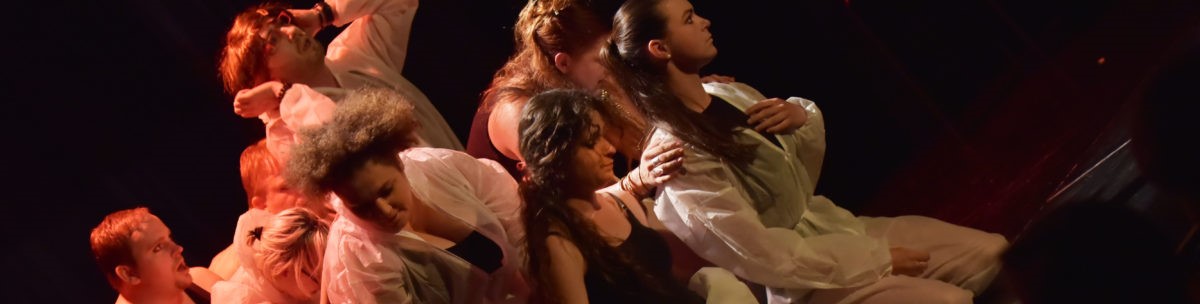


this time with director, educator, screenwriter, and dramaturge Jiří Ondra, with whom we have been collaborating at TALENT drama studio in youth groups since 2012
They say to each other, “What kind of weirdos are we,” but at the same time, they find it fascinating
I perceive Jirka as an open-minded person and a creative artist who loves wild ideas, dives into uncharted territory, and seeks meaningful challenges. He is not guided by success, but by meaning. Anything closed, lifeless, and without development he leaves behind. He also loves working with young people, perhaps because they are still full of a desire for truth and personal, creative exploration.
Do you remember the moment when I approached you twelve years ago to collaborate? Why did you decide to go for it?
I was fifty-fifty about it. I told myself I would try it for a month and see. I wasn’t sure whether I could, or even wanted to, work with this target group. I also wasn’t sure whether the two of us would understand each other. For me, that is decisive—who you collaborate with. Perhaps even more important than the group itself.
Had you worked with children or young people before Talent?
Yes, but rather on an occasional basis. At that time, I also started to focus on dramatherapy in diagnostic institutions and children’s homes. That interested me, and still does to this day. Back then, perhaps even more than working with “problem-free” young people or with theatre in general.
What did you find interesting about it?
For me, it was a kind of adrenaline. I discovered that I had a capacity I had not been aware of until then—to be on a similar level with troubled teenagers. That I was able to communicate with them, to motivate them toward some form of creative expression. It was the right kind of adrenaline, because with “problematic” kids, if you don’t activate or engage them within two minutes, they will completely reject you.
How do you perceive the boundary between authorial creation, psychosomatics, and dramatherapy?
With psychosomatics it is difficult. When you go into depth—and in authorial theatre you often do—you have to be careful not to go in too deeply in a way that could become dangerous or cause harm or trauma. In dramatherapy, on the other hand, there is a much more targeted approach to opening up problems. That is not what we do at Talent. We use the psychosomatic level in the sense of opening up an inner world that children may not initially even realise they have within them. We do not deliberately work with their personal problems and traumas, which is a major difference between dramatherapy and the authorial work we do at Talent.
How do you see Dialogical Acting, which is fundamental for Talent?
Dialogical Acting is, for me, one of many sources of inspiration. Creation is essentially a continuous dialogue. I resist distinguishing between authorial and interpretative theatre, because for me authorial work is primarily an ongoing dialogue—and that can also exist within so-called interpretative theatre. In my own work, I most often enter into dialogue with the set designer. More than situations, I am interested in the atmosphere of the performance—where it takes place, what kind of colour, character, and emotional quality the space has. I am interested in the theme or themes, and above all in the actors (human beings) who enter it. Never at the level of simply “playing what they are told” or interpreting what is written in a text, but actively entering the creative process to the extent that it is personally meaningful to them. For me, dialogicity is a completely natural way of expression—a principle of play and creation. When we talk about Dialogical Acting as a subject taught at the Department of Authorial Creation and Pedagogy at DAMU, that is something else. There, the lecturer must be able to pass on a discipline. It is very demanding to transmit something that was created by one person who saw it as their own “child” and had it completely mastered.
Paradoxically, it is not even the initial assignment, but the teacher’s subsequent feedback that I see as crucial—it is what determines what the exercise actually becomes.
It seems important to me that a person is able to give specific feedback on any acting exercise, even though we often operate on an abstract level. It is about the ability to observe a person in space and say something that motivates them to continue. As if one were speaking in codes. The other person tunes in, and suddenly you understand each other, even if it is expressed in seemingly nonsensical sentences. It only makes sense to those who are inside the process of creation, inside the dialogue. They are able to sense and understand from it what they should change or do differently. It is about the ability to lead people—specifically, to lead them within abstraction. That is quite strange, isn’t it?
Feedback should open up a path in a person—personally or creatively. Not evaluate, close it down, and be done with it.
It is important to always strike at the point that is the most sensitive—the place where you know there is a concrete wall. It must not be aggressive, but this is where our skill lies. And it has to be done in a way that does not block the person, but instead makes them think and allows them to go beyond a limit. Not to beat around the bush, not to say that everything is great and perfect. But when you see a problem, to name it in a way that creates a breakthrough.
How do you view acceptance? Not in the sense that everything is good, but that everything belongs to the space we are in.
In Talent, I find it excellent that acceptance is worked with very intentionally. Everything begins with acceptance. The aim is to deepen in people the ability to be who they are and to transform that into creation. This is a major difference between what we do at Talent and work in theatre. In theatre, ideally, there is no time for this anymore—you assume you are already working with actors who understand both themselves and you to some extent, and who already have established habits (including technique). But in our work, we take children as they are. We let them grow in all directions. We want them to open up more, to get used to presenting their work in public, to stop being afraid, and not to be blocked.
I enjoy the fact that authorial creation pulls children out of their ingrained assumptions.
I think that for the youngest generation this is becoming increasingly meaningful. The rebellion, anger, and punk attitude that I expressed very directly and naturally at that age have transformed into much more complicated forms today. Contemporary teenagers seem, at first glance, far more composed and rational. That is of course an advantage, but also a kind of trap. To a large extent, this is shaped by the whole mess happening around us—communicatively, politically, economically, ecologically, and so on. For example, as you spoke about the need for beautiful things: at present, we very much need to tell each other what is beautiful, what is wonderful. There is also a growing tendency to confirm relationships intellectually, through various rituals, to legalise and formalise something that is fragile, to bind relationships and communities through social networks. In a much greater way, a kind of “rationalisation of desire” is taking place. The desire for certainty seems to come from a strong need to have some fixed point in an increasing chaos, so that we do not lose our minds. But a fixed point is much more than just the sphere of reason. When you feel you understand everything, that is an illusion. Because, as one of our student performances says: claiming that everything is real is uninformative, because something always exceeds us and always will. So I understand this generation’s need to have things clear and certain. But at the same time, they are also drawn to something beyond certainty—a kind of mystery—even though at first some of them resist it. They say to themselves, “what kind of weirdos are we,” but at the same time they are fascinated. They consciously seek certainty, and unconsciously something that lies beyond it.
Psychologist Vladimír Chrz told me that our soul lives in images. And that the images we see—and the ones we live in—shape our lives.
That is why theatre for children is so meaningful. It develops a child’s ability to see inner images, rather than merely looking at external pictures. I am glad that there are many children’s theatres that do not serve prefabricated beauty to children, because that is ultimately useless. This is also where the deep value of fairy tales lies—they have always been preparation for real life. They contain a certain lived experience. If good does not properly defeat a sufficiently strong evil, the fairy tale loses its meaning. That is why I am interested in theatre for children. It offers the possibility of shaping the aesthetic and experiential layer of a young human being. And as for images: an image is a carrier of information. It does not have to illustrate that information or reality directly—it can emerge associatively.
Can you tell me more about the rituals you work with?
I work with rituals intuitively—it simply happens. Even in contemporary theatre. Suddenly you watch what is emerging directly in rehearsal, and in that moment it feels magical, almost sacred. Sometimes you don’t even understand what it is about; things happen by so-called coincidence, or arise through associative layering. But I am interested when the principle is informed and not self-serving—that it does not feel merely random or like vague “spirituality,” but as if a certain subconscious layer has revealed itself. And you are able to name it afterwards and repeat it. That is how something begins to become ritualised. From free expression, rituals emerge that repeat throughout human history—and at the same time often become emptied of meaning. It is fascinating to observe how something that begins in absolute freedom can spontaneously take on form, without being deliberately directed or staged. In doing so, you rediscover a ritual that has been inscribed in humanity since ancient times. As Mircea Eliade writes, the creation of the world is continuously repeated, and mythological beings keep appearing in the world without being aware that they are such beings—for example, ordinary inhabitants of a modern city. And suddenly you see Orpheus, Charon, Eurydice around you. Myth and ritual continue to inscribe themselves into human life. The only difference from ancient Greece is that they lived mythology as part of everyday reality. We have, in a sense, forgotten it or stopped perceiving that layer. Back then, myths, rituals, and mythic figures were fully present in everyday awareness—but that does not mean they cannot be present today.
Jung called this archetypes.
But I think it was not only the characters—ritual and myth were also a natural part of everyday life. The Dionysian festivals were a multi-day event; people would come and go, eat, drink, and it was comparable to how football functions for us today. Poetry was part of everyday existence. Singers and reciters performed in taverns and in the streets. Ivan Diviš, in a lecture from about twenty years ago, said that the only place where something like this still exists is Ireland. Today, someone publishes a book of poetry, 150 copies are printed, 50 people read it, and that is the end of it. The original social function of poetry has been lost. I do not mean that there is no point in writing it anymore.
Let’s return to Talent. Why does it still interest you?
Primarily, it has moved us as well—it is not only about the journey of the children. If you look at what we were doing twelve years ago and what we are doing now, there is a clear shift. The fact that it keeps continuing and moving toward something increasingly uncharted is important. You are constantly forced to stay active, because new children arrive who do not know what came before. You cannot simply apply what you already know to them—you have to start from them. So you have to reshuffle everything again and transform it.
I like that whatever crazy idea I have said, you have never said no.
Your crazy ideas are great—they motivate me. For example, Radka Fidlerová, with whom I teach at an acting school, could tell you about that. Sometimes you discover that it works, but most of the time, of course, it doesn’t. In the words of McMurphy in One Flew Over the Cuckoo’s Nest: “But at least I tried, goddammit.” That is exactly what it is about—to try it.
What are the best and worst moments you’ve experienced in Talent?
One of the best moments we have experienced was just recently. What Vosí hnízdo created together is so far our creative milestone. It is not only about the performance itself—I am also happy about how something so strong can emerge through such a free way of working. I am always glad when this approach succeeds in forming a coherent shape. It is always a small miracle. Unpleasant moments come when a group starts to fall apart. But that is also natural—it is part of the development of a group. So far, we have always managed to hold it together and get through it. And then something new comes again—a kind of renaissance. In Talent, there are also small histories unfolding.
What would you say to children and the younger generation?
Whether a person has ambitions to do theatre at a professional or non-professional level, they should try it. It is a valuable experience to step out of your comfort zone and consciously work with it in an authorial way, to go on an adventure. A live encounter—and the very ability to express yourself in space on your own behalf—is sometimes far more adventurous than, for example, social media. It is a much greater adrenaline.
Can you compare drama clubs based on rehearsal, authorial creation, and improvisation?
Rehearsal-based drama feels pointless to me. If we are talking about a drama club that only rehearses, I would call it a “bad drama club.” It gives nothing to anyone and only fulfils the ambitions of the leader. Then there is authorial creation. That is a broad term. I include under it theatre in which the entire creative team actively enters the process in an authorial way. Authorial work offers space for self-development and self-discovery—that is what we touch upon in Talent. Improvisation can be a tool, a good form of exercise or technique. But sometimes what is called improvisation is actually closer to variety-style sketches, and those also don’t have much meaning. As for improvised performances, I cannot imagine doing them with children—they are in fact also a trap. For me, improvisation works best as a means that can be used within authorial creation. And if it doesn’t work and the children do not want to, there does not have to be a performance at all.
But children want performances, and I think they are important. They realise that their creation has meaning. They write a text or create something that reaches or affects other people.
It is a good thing that children want performances. It is connected to responsibility—that their work is moving somewhere. It is just important that they realise it is not about exhibitionism. That a performance does not mean showing off what I can do, how good I am, or that I can do a headstand. It is about having truly created something. Something that has meaning, or that can speak to someone else.
A shift away from self-centredness toward creativity.
Yes. That is something I like about Talent—that it is moving in this direction.
Thank you for the interview.
Erika Merjavá